



A major regional bank relied on fast and reliable processing of over 100,000 documents each month — from payment slips and payroll lists to credit documentation and long‑term archives. These processes were essential for maintaining daily operations, meeting strict cut‑off times and ensuring compliance. As volumes grew and client expectations increased, the bank needed a more efficient, scalable and modern approach to document processing.
By implementing CapturePoint, ASEE’s AI-driven document capture platform, the bank achieved near-perfect OCR accuracy, reduced processing times from minutes to seconds, and eliminated the operational limitations of their legacy system — without disrupting existing workflows.
The Challenge: Legacy Capture Platform Failing at Scale
The bank’s legacy capture platform struggled to keep pace with operational demands. Document classification accuracy reached only 30–40%, making the system highly sensitive to form or layout changes. Printed OCR accuracy hovered around 70–80%, while handwriting recognition was even weaker at 20–30%, resulting in extensive manual correction. Processing a single document often took several minutes, creating bottlenecks during peak times and putting time‑critical workflows at risk. Additionally, every volume overage triggered significant licensing costs, and even minor configuration changes required complex, time‑consuming interventions. The organization needed a more reliable, accurate and future‑ready solution capable of replacing the legacy platform without disrupting established processes.
The Solution: AI‑Driven CapturePoint
ASEE implemented CapturePoint, a modern and highly flexible AI‑based platform designed to eliminate limitations of legacy capture systems and automate document processing at scale. Instead of relying on rigid classification templates, the platform focuses on extracting only business‑relevant information using AI‑driven OCR for printed, handwritten and tabular data.
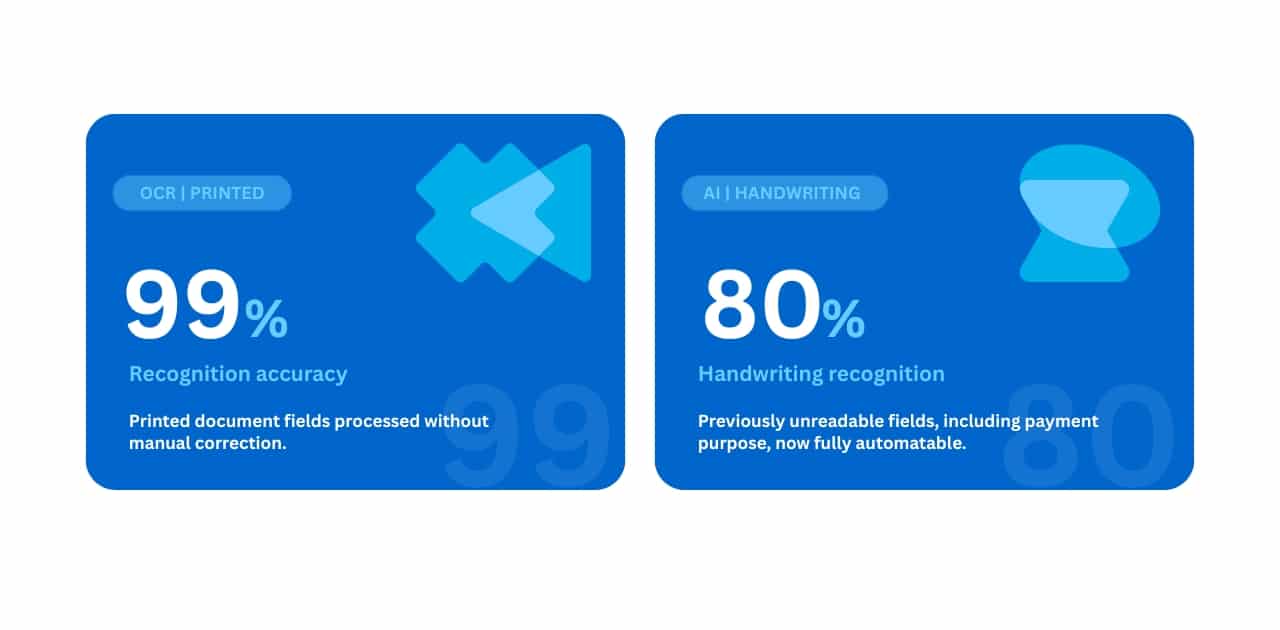
Printed OCR accuracy increased to ~99%, while AI‑based handwriting recognition reached ~80%, making previously unreadable fields — including payment purpose — fully automatable. Automatic table detection replaced manual zoning and significantly accelerated processing of payroll and loan lists. With exception‑based validation, users now interact only with documents that require attention, instead of manually reviewing each one.
CapturePoint’s modular architecture allows new document types to be introduced within days, and its monitoring tools enhance transparency, stability and incident resolution. Leveraging ASEE’s deep domain expertise, the migration was delivered smoothly and without disruption to existing downstream systems, enabling the bank to transition safely from outdated legacy technology to a modern platform.
Results & Measurable Impact
✅ Exceptional Accuracy Improvements
- Printed OCR accuracy improved to ~99%
- Handwriting OCR accuracy increased from 20–30% to ~80%
- Classification fully eliminated, removing a major source of errors and maintenance effort
✅ Significant Process Acceleration
- Document processing times reduced from minutes to seconds
- Automatic table extraction removed the need for row‑by‑row manual correction
- Validation workload drastically reduced through exception‑based handling
✅ Operational Efficiency
- Fewer manual corrections — Previously, staff spent significant time correcting erroneous data. With improved data quality, that role has evolved: what were once “validators” are now “controllers” focused on exceptions.
- Faster investigation and resolution of production issues
- Simplified system administration with fully transparent, auditable workflows
✅ Financial Benefits
- No more overage licensing costs from the legacy system
- Lower total cost of ownership
- Faster onboarding of new document types without additional development cycles
✅ Scalability & Future Readiness
- Architecture prepared for straight‑through processing
- Adapts easily to new document types, business rules and process expansions
- Supports long‑term growth and rising document volumes
Why This Case Matters
This transformation demonstrates how CapturePoint’s flexibility, modern architecture and AI‑driven capabilities can modernize even the most complex, high‑volume document environments. By replacing outdated technologies with a future‑ready, scalable platform, the bank achieved higher accuracy, faster processing times, reduced operational effort and lower long‑term costs. Thanks to ASEE’s strong expertise in migration and process modernization, CapturePoint delivers measurable value from day one — and provides a solid foundation for future automation initiatives.
If you are ready to elevate your document‑processing operations with a more flexible, modern and future‑proof platform, CapturePoint is the right next step. Backed by experts with deep, hands‑on experience in replacing legacy systems, it gives you the accuracy, automation and scalability your organization needs — with a pricing model designed to deliver long‑term value without unnecessary cost.
Get in touch to discover how you can modernize your processes — smarter, faster and more cost‑effective, without compromising on quality.
FAQ:
What is CapturePoint?
CapturePoint is ASEE’s AI-driven document capture platform that automates OCR, classification, and data extraction for high-volume enterprise document processing.
What OCR accuracy does CapturePoint achieve?
CapturePoint achieves ~99% accuracy for printed text and ~80% for handwritten content. This represents a significant improvement over legacy systems, which typically reach 70–80% printed OCR accuracy and only 20–30% for handwriting
How long does document processing take with CapturePoint?
With CapturePoint, document processing time can be reduced from several minutes per document to seconds. This was critical for meeting daily cut-off times and handling peak processing volumes.
Can CapturePoint replace a legacy document capture system without disruption?
Yes. As mentioned in this case study, ASEE migrated a high-volume legacy capture platform to CapturePoint without disrupting existing downstream systems or established workflows. The migration was delivered smoothly thanks to ASEE’s domain expertise in document processing modernization.
How quickly can new document types be added to CapturePoint?
CapturePoint’s modular architecture allows new document types to be introduced within days, without additional development cycles. This eliminates the long configuration timelines associated with legacy capture platforms
What document types does CapturePoint process in banking?
In this banking deployment, CapturePoint processes payment slips, payroll lists, credit documentation, and long-term archive documents.
Latest Posts


Leverage the expertise of over 200 professionals to optimize your business
Start now